Showing posts with label procedures. Show all posts

Monday, June 20, 2011

Wilderness hexes as dungeon rooms - Putting the "howl" in "howling wasteland"


I have a million good resources to stock wilderness areas. Choosing between them and then deciding how to apply them is the trick. My main source material for this latest campaign has been the monster encounter tables from the B/X rulebooks, and the Judges Guild random ruins tables to give the areas some character. Once you're used to the JG tables, one line can easily provide a launching point for tons of spot detail. But every ruin having a monster ends up being a bit excessive. And you certainly don't want a substantial treasure at each location. Nor do you want every entry to be a deathtrap. Of course you can just use your judgement, but the programmer in my likes to have a methodology to start with (which I then freely ignore to taste).

Then it occurred to me - why not just stock the hex like I was stocking a dungeon?

Using the dungeon room contents table from B/X, 2 of 6 rooms have a monster, 1 in 6 a trap, and 1 in 6 have "special" contents (the remainder standing empty). Rooms with monsters have treasure fully half the time, while trapped and empty areas contain loot less frequently (2 and 1 in 6, respectively). This, for me, is a perfectly acceptable ratio for outdoors areas, and it's scalable to whatever level of detail / population density / ruin frequency you want.

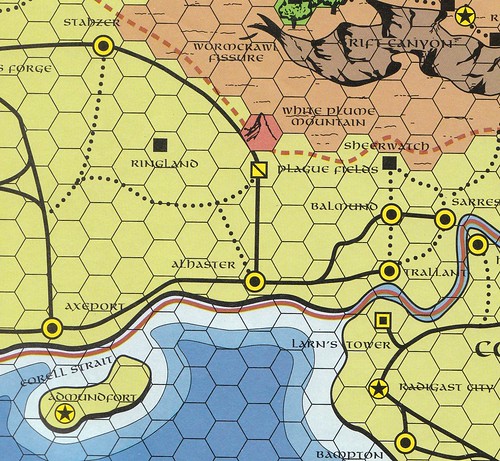
For example, I needed to stock a 10 hex x 10 hex area in a hurry for our last game. I went through every hex in order, rolling d2 ruins results for each one. For each of these ruins, I rolled the standard d6 dungeon contents roll - if monster was indicated, I stocked the lair from the Expert Set tables (note that more than a few of these end up being men or demihumans). If it came up trap, the item/location was described as being potentially harmful to the players (this is a great way to throw in wilderness hazards like rockfalls and quicksand, BTW). "Special" results got "lost world" / weird fantasy-type stuff (gates, lasers, dreamworld crap, etc.), and empty "rooms" just got an unihabited / unguarded ruin or relic.

This process went smoothly enough with a notebook just jotting notes - when I added Tablesmith to the mix, it got a hell of a lot faster. JudgesGuild.com has the Ruins & Relics tables in TS format, which is just beyond fucking awesome. (TS is free to use, but there's a $10 registration to disable the nag - I STRONGLY advise you to check out the program and see if you don't think 10 bucks is actually a steal, and to consider registering.) This is an amazing piece of software for anybody that loves tables. You know you want it.

So, basically I end up with 100 hexes, each with one or two "somethings" in it (on top of the handful of locations already included from the Silver Princess wilderness map). Enough of those are monster lairs that you can get in a fight in maybe every other hex without me adding new creatures to the map, which is about right for the "first stock" by my tastes. As the players wander they'll uncover (and/or slaughter) map contents gradually, but the timed encounters will also _add_ new results to the map - so "restocking" is, I guess, almost automated? We'll see how that works in play, at least.

- DYA

Monday, December 14, 2009

Wilderlands of 'Hawk Fantasy - Hexcrawl Notes


In designing the wilderness area for my Greyhawk campaign, I'm finding that I have a million and one choices to make as to my "wilderness procedures", and that these will shape a) how I prepare my material, and b) how smoothly the game runs when we're in the thick of it.

It all comes down to encounter checks (of several varieties). In order to capture the level of simulation (and risk vs. reward) I'm looking for, I'm going to have time-based encounters (as per the DMG - checks at predefined intervals during the day) and exploration-based encounters (1 check for every new hex entered, probably a 1 in 6 or a 1 in 10, with the chance for encounter increased in dangerous hexes like mountains and forests). Exploration checks will draw from nearby lairs (with a chance to find the lair itself based on "% in lair"), while time-based checks will be from a terrain-based encounter table (and may add new lairs to the map, again depending on the "% in lair" rolled). Encounter checks within a few hexes of settlements will have a chance of being converted into a "patrol" encounter (which may or may not benefit the PCs, depending on what they've been up to lately), while encounters on a road or frequently-traveled trade route will use a dedicated "on the road" encounter table (which itself contains a certain chance of monster encounters).

I'm also splitting "creature checks" (monsters, travelers, patrols, etc.) from "location checks" (ruins, relics, settlements, etc.). Passing through a hex, I'll roll a "chance to spot" for each listed (and previously undiscovered) ruin or relic in the hex (setting this on-the-fly - something small but in the open would be a 1 in 6, something big a 2 in 6, a settlement 3 in 6 assuming it's out in the open, while something concealed might be a 1 in 8 or 1 in 10). Searching a hex will take as long as crossing the hex twice, and will allow another roll to spot (with the chance to spot improved by 1). If the PCs spot nothing (or they've already discovered everything in the hex), I'll roll a 1 in 6 chance to discover something new (taken from a pregenerated list of unassigned R&Rs) and add it to the hex. (I expect frequently-traveled wilderness routes will become quite detailed as the campaign matures.)

Now, I know the chances to spot something in an actual 25 square mile area are miniscule, but this is a game conceit I'm willing to live with. I'm generating between 1 and 3 locations for each hex on my initial pass-through - it's to be assumed each hex contains many more than this, and that the others will be added on subsequent passes (once the pregenerated ones are discovered). This is all conjecture until it actually sees play, of course - I'll hopefully get to try it Tuesday, and I'll check in to report how it goes. I'm aiming to have three full "Darlene hexes" (the 30-mile hexes from the folio map) detailed at "Wilderness Grand Tactical" scale (5-mile hexes) by then, and I'll let the players know that if they get off that map, then the FPS (fights per second) of the game is going to slow drastically (while I whip up new crap).

-DYA