Showing posts with label B/X. Show all posts

Thursday, February 7, 2013

In Search of Adventure (Young Lord Steakfist Goes Forth)

Well, hell, that was fun.

Wednesday's been kind of a big deal, lately - Wednesday is the night I actually get to PLAY D&D. Like, as a player. Most of the time, I'm the one running the games. (Sure most of you know how that is.) However, over the last 6 months or so, I've gotten to try out Dungeon Crawl Classics RPG, gotten into a good handful of Labyrinth Lord sessions, and even banged out a session of our buddy's mythic Greece AD&D campaign. It's cool to get some time on the other side of the screen. (Heavy is the head that wears the Viking Hat, after all...)

This week, though, a slot opened in our Wednesday night rotation, so I kicked off a new Classic D&D campaign of non-specific vintage. I'm using the Rules Cyclopedia as my reference, but the players are all using '81 Moldvay Basic books. Beyond telling the guys that thieves can't use two-handed weapons, it's close enough for government work - if anybody gets to Companion level, we'll address the differences. We're using GAZ1: The Grand Duchy of Karameikos, B1-9 In Search of Adventure, and my modest pile of B Series modules for background and adventure material. Compared to our usual Monday Forgotten Realms game (where my... well-stocked Realms library can be a double-edged sword, sometimes), this is a nice slim set of sources to work with, and of course Basic is just a whole other order of simple compared to drink-from-the-firehose-style AD&D. It's liberating.

Now, I know it's base heresy, but I am enjoying the added minute or so the GAZ1 background tables add to B/X character creation. (For human characters, it amounts to 3 rolls, less for demihumans.) We get to find out a human PC's social standing, ethnic background (native Traladaran, Thyatian, or mixed), and their hometown. I'm firmly in the "character is what you do, not what you write down" school, and I like to see players develop their PCs in play. Two-page backgrounds are not encouraged in our games, much less a requirement. But with just 3 pieces of information, the guys were spinning off all kinds of speculation about their characters' place in the world, their family structures, and their relationships to each other. Great signal-to-noise ratio - once these guys are at Expert level, and their adventures expand in scale a bit, we'll have plenty of grist for the mill. We already have the illustrious dynasty of Lord Steakfist (and their ancestral home, "Castle Planet Fitness") contrasted with the ill-fated and penniless Brownwater clan of Black Eagle Barony (poor Dunder escaped that blighted land concealed in a pig cart, got killed in the face by a giant shrew in the first encounter, and was in short order replaced by his brother Slipsun). Great stuff.

Let's talk about the source material a bit. In particular B1-9. I've seen this collection get a lot of bad press from completist Mystara folks, and on one level, I can see why. The premise is that it's a collection of the first 9 B Series adventures (I'm with you, so far), and that they're threaded together in a loose campaign - not a lead-you-by-the-nose "adventure path", but a branching web of adventure hooks that allows the players the lead in navigating (a great idea, and - even if you don't use the adventures presented - it shows how this can be done, which is an important lesson for new DMs using published material). Unfortunately, several of the adventures presented are chopped for space, and I have to question the decisions made on what got in and what didn't.

B2 Keep on the Borderlands is included, but the Keep itself (one of the most iconic base towns in the hobby) is reduced to a paragraph describing the castellan brushing off the PCs. B3 Palace of the Silver Princess (the green, published version, not the extra-spicy orange version) is included, although the "programmed adventure" Chooose-Your-Own-Adventure content is skipped. (I don't miss it - as a matter of fact, this version is in some places better-presented than the original.) B4 The Lost City is here, but only the top levels of the complex are provided - the unkeyed lower levels are missing. (This kinda sucks - for play value vs. page count, a few more pages with the lower level maps would give a DM running this a lot more potential mileage.) B5 Horror on the Hill has its mini-wilderness area amputated - while I haven't run this one, a friend is running the original for two groups right now, and he tells me this is an unfortunate omission. Tracy and Laura Hickman's B7 Rahasia is here, both sections in their entirety. (With the original Daystar West Media printings, publication as RPGA1 and RPGA2, and subsequent compilation as B7, this is the fourth incarnation of these adventures!) B8 Journey to the Rock (a tournament adventure) is presented, slightly slimmed down. B9 Castle Caldwell and Beyond (itself a loosely linked collection of scenarios) gets 4 of its 5 mini-adventures seeded into the larger work, and the 5th is dropped. Finally, B6 The Veiled Society is the thread that ties the whole thing together - all roads lead to Specularum, and any of In Search of Adventure's three main threads will bring the PCs there to deal with the machinations of the Veiled Society. It is presented with the map from GAZ1 (as opposed to B6's earlier Specularum cartography), and sans cutouts or stand-ups, but is otherwise unexpurgated.

And poor, poor B1 - the original Basic Set module, the one that started it all, gets reduced to two half-page maps, unkeyed, and a single rumor. Not a line of the text makes it in. I can see, if I squint, where the "key your own dungeon" aspect would make it easy to lay this one on the chopping block, but I think it's a glaring omission - beyond the historical significance, these are some of the most iconicly weird room descriptions around, and exploring Quasqueton's baffling labyrinth is one of the hobby's major shared experiences. Devoting less than two pages sorely underutilizes Mike Carr's work on this foundational text.

So I can see where this collection gets its tawdry reputation from. Beyond the missing material (and make no mistake, this still clocks in with the AD&D megamodules on pagecount), the links between scenarios are tenuous - that they're not on hard rails is a feature, not a bug, but it will require a self-motivating party to navigate from one scenario to another. (The hook for B7 Rahasia, in particular, is... barely there - it amounts to, "Hey, there's this guy, an elf I guess, he wants you to play FedEx, and there's no reward offered - do you do it?") That said, there's a great campaign here if you're willing to fill in the holes. It presents Threshold (as detailed in the Mentzer Expert Set, and expanded upon in GAZ1) as the "base town" where the PCs meet, equip, fish for rumors, and return to should they ignore the scenario links presented in the "interlude" sections of B1-9. It provides some basic wilderness movement rules (nice if you're running this without access to the Expert Set and you want to handle such things in play). And the overall structure of modules is solid - a smorgasbord of Basic-style dungeons, culminating in a first foray into city adventuring. The whole thing would lead seamlessly into either the proto-Expert Set play of B10 Night's Dark Terror*, or the hardcore hexcrawl of X1 Isle of Dread. It just takes a DM willing to shore up the superstructure.

Looking at the table after tonight's game, I'm especially struck by what a complete game one could run with the Rules Cyclopedia, GAZ1, and B1-9. That's a lot of stuff in 3 books. As it happens, I have copies of B1 through B4 on hand, so I'm using the originals in tandem with the compilation material to bulk things out a bit. But you could do without.

So, I'm using my super-scientific review process and slapping a B minus on B1-9. It's just a ton of material, flaws notwithstanding. And it's worth pointing out that, of all the modules ever released, B1 and B2 are far and away the most common (and the ones that are most sorely missed here). If you're running B1-9 In Search of Adventure, spend five bucks tracking down B1 and B2, and you'll have upgraded this megamodule to a solid "A".

- DYA


* Formerly available on eBay for the price of 10 talents of gold and an orphan's heart, this classic - the last thing the TSR UK team would do before defecting to GW and creating the legendary Enemy Within campaign for Warhammer Fantasy Roleplay - is now available in PDF format on www.dndclassics.com for a paltry sum. It's a great time to be a gamer.

Wednesday, June 29, 2011

Medieval Demographics (or, "The Peasants are Revolting")


If you don't know about this, well, you're fucking up. I don't know what to say. This shit (the Domesday book) has been up for a long-ass time, I vaguely remember consulting it regularly when I was running my d20 Cormyr campaign (which was a LONG-ASS TIME ago), and it's sprouted features since then.

What I'm interested in here is "how many people can [x] hexes of arable land being worked at [y] relative efficiency feed?" Domesday Book takes easily-arrived-at figures and gives you projected data on how many settlements the land will support (and of what size), how many fortifications will be required to hold the land, what size standing security force (guards, watch, etc) will be present, and how many of several key professions will be supported by this domain. (It's not ideal, for my purposes, that it uses kilometers, but beggars can't be choosers.) (Pretty sure it says that in the DMG somewhere, at any rate.)

Now, I'm actually using Midkemia Cities to generate my city professions, and there is some assumed demographic info there, and there's some figures from the Wilderlands booklets that have other figures, so I'm still kinda juggling all 3 just to see what feels right. The irony in all of this is that this shit won't matter for quite a while, but once players are at the "worrying about domains" stage of the game, it'll be too late to change all of this crap without serious re-working, and I'm gonna want a clear picture of the situation at the commencement of full-on armies and politics shenanigans.

- DYA

P.S.: Oh yeah, the map is from Darklands, the best open-ended sandbox RPG set in the Holy Roman Empire that nobody's ever heard of.

P.P.S.: Oh, and here's Michael Bolton as Captain Jack Sparrow.

Thursday, June 23, 2011

Medieval Professions by Social Class (or, "Get a Job, Hippie")


This is pretty sweet. A list of medieval professions at arcana.wikidot.com. They're grouped into broad specialties (farmer, artist, etc.) but the actual professions themselves are nicely granular (as the very guild-oriented professional classes tended to be).

This is relevant to my interests, BTW, because I'm attempting to cobble together a rough profession-based "no-system skill system" for D&D (or "insert your pseudo-medieval European fantasy game here"). Basically, just a roll on the social class table from the Unearthed Arcana, and a second roll on a social class sub-table of professions - each one gets a handful of skill names (some of which you might have only a 25% or 50% chance of actually acquiring), and that's it. No numbers, no rules whatsoever, you just have those skills, write'em down. If it comes up in a game, we'll deal with it during the game.

Luckily, I'm the proud owner of Gary Gygax's Living Fantasy, and that book lists an astounding array of medieval professions, and it groups them using the same class hierarchy (lower-lower through upper-upper) that the UA does. (Shocker, huh? :D) so between that, the above link, and a few other online resources, it shouldn't be a huge chore to at least put together fairly comprehensive profession lists. From that point, I can pretty much just fill in the interesting ones as I go along - if "land court bailiff" or whatever isn't represented on the skill list, I'm sure nobody will kick.

We did a very tentative test of this at the game tonight; we know know that the fighter is from an upper-class military background, the thief is the son of a well-to-do merchant, and the elf's parents were wealthy antiquarians. (Which of course means so far nobody knows how a shovel or a mop works, or how to navigate by the sun or the stars, for example.) (Should I run a polo-themed adventure, they're all set, though!)

- DYA

Monday, June 20, 2011

Dirty Dungeons, Done Dirt Cheap

So, this is pretty choice. DIZZY DRAGON'S ADVENTURE GENERATOR

It's not too terribly dissimilar from a double handful of similar tools (and the more the merrier as far as these go, the usefulness increases along with the variety), but this one a) creates a fairly tight "maze"-style dungeon via geomorph, b) stocks them with B/X creatures (or just Basic, or d20), and c) creates some detail with results from the DMG dungeon dressing tables. The dungeons definitely have a certain style, and wouldn't use them for everything, but for a couple of quick "just in case" dungeon levels to toss on the wilderness map? Perfect.

- DYA

Wilderness hexes as dungeon rooms - Putting the "howl" in "howling wasteland"


I have a million good resources to stock wilderness areas. Choosing between them and then deciding how to apply them is the trick. My main source material for this latest campaign has been the monster encounter tables from the B/X rulebooks, and the Judges Guild random ruins tables to give the areas some character. Once you're used to the JG tables, one line can easily provide a launching point for tons of spot detail. But every ruin having a monster ends up being a bit excessive. And you certainly don't want a substantial treasure at each location. Nor do you want every entry to be a deathtrap. Of course you can just use your judgement, but the programmer in my likes to have a methodology to start with (which I then freely ignore to taste).

Then it occurred to me - why not just stock the hex like I was stocking a dungeon?

Using the dungeon room contents table from B/X, 2 of 6 rooms have a monster, 1 in 6 a trap, and 1 in 6 have "special" contents (the remainder standing empty). Rooms with monsters have treasure fully half the time, while trapped and empty areas contain loot less frequently (2 and 1 in 6, respectively). This, for me, is a perfectly acceptable ratio for outdoors areas, and it's scalable to whatever level of detail / population density / ruin frequency you want.

For example, I needed to stock a 10 hex x 10 hex area in a hurry for our last game. I went through every hex in order, rolling d2 ruins results for each one. For each of these ruins, I rolled the standard d6 dungeon contents roll - if monster was indicated, I stocked the lair from the Expert Set tables (note that more than a few of these end up being men or demihumans). If it came up trap, the item/location was described as being potentially harmful to the players (this is a great way to throw in wilderness hazards like rockfalls and quicksand, BTW). "Special" results got "lost world" / weird fantasy-type stuff (gates, lasers, dreamworld crap, etc.), and empty "rooms" just got an unihabited / unguarded ruin or relic.

This process went smoothly enough with a notebook just jotting notes - when I added Tablesmith to the mix, it got a hell of a lot faster. JudgesGuild.com has the Ruins & Relics tables in TS format, which is just beyond fucking awesome. (TS is free to use, but there's a $10 registration to disable the nag - I STRONGLY advise you to check out the program and see if you don't think 10 bucks is actually a steal, and to consider registering.) This is an amazing piece of software for anybody that loves tables. You know you want it.

So, basically I end up with 100 hexes, each with one or two "somethings" in it (on top of the handful of locations already included from the Silver Princess wilderness map). Enough of those are monster lairs that you can get in a fight in maybe every other hex without me adding new creatures to the map, which is about right for the "first stock" by my tastes. As the players wander they'll uncover (and/or slaughter) map contents gradually, but the timed encounters will also _add_ new results to the map - so "restocking" is, I guess, almost automated? We'll see how that works in play, at least.

- DYA

Tuesday, June 14, 2011

Everything You Always Wanted To Know About Saving Throws (But Were Afraid To Ask)


Hahaha... So, every once in a while, dredging through the open sewer that is RPG.net yields a nugget of wisdom, nestled gently amongst the turds. This is pretty great:

ENTER THE VANGUARD OF ROLEPLAYING *snort* *snigger*

It's a discussion of old-school saving throws, and the perceived reasoning behind them. I've seen this kind of thing on Dragonsfoot here and there, but not with this level of thought and illustration. Worthwhile reading, I'll have this in the back of my mind next time I pull an, "ok, save vs. [THING]" out of my ass in-game.

Monday, June 13, 2011

Valley of the Silver Princess (or, "How to See Gulluvia On 50cp a Day")


Running House D&D this Wednesday, or so I'm told. ("House D&D" being "Basic D&D with housemates and associates, including girlfriend-types and not specifically aimed at super grognards the way we usually roll around here".) Last time (the first time), we ran one session of the (banned) orange-cover version of B3 Palace of the Silver Princess (weirdness very much in - see HERE for details (UNLESS YOU'RE PLAYING AND THAT MEANS YOU, YOU SNEAKY ENGLISH K'NIGITS)). They spent most of the session getting there (jumping around city roofs and playing 007 before getting to the green dude with the hook), and then proceeded to make it a hundred feet or so in, blunder into a pit trap, and get their asses more or less handed to them by militaristic kobolds. Barely managing to force a failed morale check, driving the overly-effective dogmen away, the party limped back to the entrance, short a player character.

So now they're in need of warm bodies and an outfitter. (Besides the dead PC from last time, we may have one or two new players.) They're in poor shape for the "wander around until we inevitably run across imprisoned adventurers" thing, so that means travel. I'm loathe to handwave such things - sure, you can say "you get to town X with Y random encounters on the way", but I dig when things evolve a bit more organically. TO THE MAPPING CHAMBER.


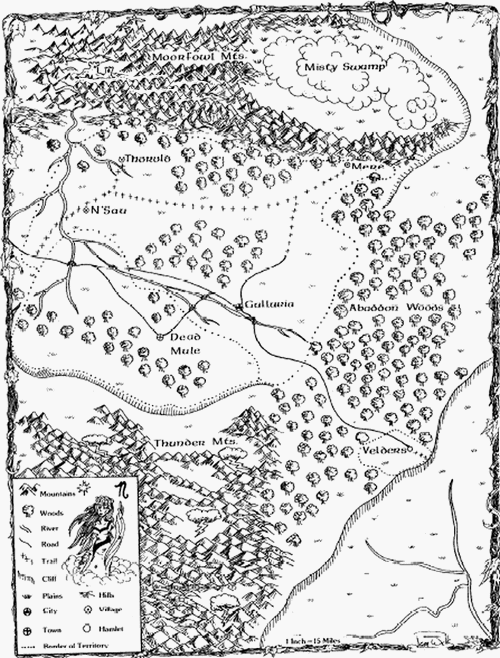
I'm basing this on the overland map in (orange-cover) B3, sort-of-mostly shoehorned into the corresponding area from the Mystara map included in the D&D Rules Cyclopedia. Which is not to say I'm giving much if any weight to the Mystara stuff that's gone before - the material from B3 is pretty clearly out of line with what's been published for this area since, and I'm not a huge Mystara scholar anyway - but I figure I have the RC, and the pretty map pages in it, I may as well make use of it for the surrounding areas. Most of what I've done here is actually just North of the extreme Northwest corner of the RC Mystara map - which also means that the Western border of my map is "off the charts", even in the source material. So that's where I can get freaky-crazy - I'm envisioning a vast, weird steppes area populated by barbarians and giant animals (stolen from Judges Guild, natch), with a spice road across it and lots of "on the road" zaniness. With a nice, dangerous reputation to keep folks away from it before I've actually done any of the design work, of course. :D

With that context in mind, I spent some time mapping the locations and routes (roads, paths and rivers) from B3 onto my RC-based hex map. (Using the 5-mile Judges Guild scale for this.) (Yes I know it was supposed to be 15 miles, no I don't care.) Some map distortion crept in getting things to fit where I wanted them, but I managed to more or less preserve the distances between locations, so fuck it. From there, we have a pretty bare map. Time to flesh it out.

Using the "habitation" table from the AD&D DMG (pg. 173), I rolled the "chance of habitation" for every hex in a 15 x 15 hex area. Any weird results (assuming that the main towns were those on the map, and that there weren't a bunch of extra cities, for example) were massaged out (either moved somewhere useful, or ignored). Got a bunch of small thorps & hamlets, a ton of individual settlements / camps, and more than a few ruins. Using the "race of settlement ruler" table from Kellri's GDD#4, we find that there are a lot of displaced dwarven settlements in the area (presumably refugees from the Palace's fall) (used tons of Dwarf Fortress names for these, of course), and a couple of powerful retired adventurers living in the valley as well.

And here's where we're at (with water colored in, figuring not much there is gonna change or need erasing at this point):


With the terrain and main settlements arrived at, I have a pretty good basis to fill in the blanks with lots of results from the Judges Guild ruins & relics table, and then it's hexcrawl time. YEEAAAAAAAAHHHHHH

- DYA


Edit: I figured it'd be illuminating to include the map I based my work off of. So there.

Friday, March 25, 2011

Repurposing Battletech Maps (or, "Re-Re-Inventing The Wheel")


School is very very crazy and gaming is pretty few and far between, lately, so I was psyched to have a chance to break out the Battletech stuff (for the first time in a loooong time) the other day. (Got two weeks off until it's back to Crazy Robots and Polygonland.) Introduced one of the roommates to tabletop BT - he's an old hand at the PC series, so most of it was already familiar. We did a pretty standard "attack/defend" scenario, just 'mechs (no combined arms stuff like tanks or infantry) and strictly 3025 designs (and level 1 rules). Today we'll probably do something similar, and then maybe we'll start working in the non-'mech stuff. I've always been curious how that mode of play goes - all my BT experience has been strictly 'mech-on-'mech.

So I'm reading the Mechwarrior book (the RPG chocolate to BT's boardgame/mini hybrid peanut butter), and there's discussion of running man-to-man combat using the standard Battletech maps (with a 5 meter to a hex scale). This looked lke fun, but it also occurs to me - why not use Battletech maps for other games where outdoor combat comes up a lot? I've never been a huge fan of wilderness layouts drawn on battlemats - visually it just doesn't work for me the way it does with dungeons - but I already own a big pile of hexed-out terrain sheets, with beautiful art no less. Next time I have occasion, I'm gonna whip out a few BT mapsheets and see how it flies. (The big decision: What scale to use (the hexes are a little bigger than the 1" I'm used to on my mat), and whether to bother restricting figures to the hexes, or to just use a ruler (a la traditional mini wargaming).

Of course this repurposing thing is nothing new - our learned and crusty readers will already be aware that Avalon Hill's Outdoor Survival map was the original wilderness map for Gary's home game. Has a nicely circular feel, this.

It occurs to me as well that AD&D inherited OD&D's outdoor scale of 1" to 10 YARDS (as opposed to feet, as it is in indoor settings like the dungeon), and off the top of my head I can't remember whether Classic D&D followed suit. (The next chance I'll likely get to use this is our still-fledgling house Red Box game - the guys (and gal) came out of the Palace of the Silver Princess with one less adventurer than they went in with, and are considering making the trek down out of the mountains into the valley below, in search of able sword-arms and a decent outfitter.)

This would be a great fit for Traveller, as well, especially if I ditch Trav's assumed scale - the old Snapshot ship maps are beeeeyootiful, but who the hell wants to track down 15mm sci-fi minis when most everything else I play is 28mm and up?

- DYA

Saturday, March 6, 2010

Drunken one-off crawl pt. II: the revenge

So I promised either a session report or falling asleep in the comments section of last post; I delivered on the latter promise. Here's the former.

Our stalwart troupe of hastily-named adventuring-type folk entered the Catacombs of the Necromancer via the timber lift ensconced in the ever-so-aptly named Stinky Hole tavern. The lift brings one to "The Training Grounds" (AKA Level 0, AKA The Rat Warrens), an area where (according to the talk around town) a small, inexperienced group of adventurers may hone their craft without exposure to the more-terrifying terrors of the deep. (Basically, yeah, it's a rat-whomping newbie level straight out of CircleMUD - a little tribute to a huge time-waster of my youth.) One of the standard rumors concerning the Catacombs details the way to "Level 1" and the dungeon proper (first right, first left, first right) but Angus said to hell with that. (IIRC, the last Basic game anyone in our circle played was my boy Matt's, wherein they lost 30 PCs in a night, so maybe his caution is justified.)

The party (consisting of, I believe, a fighter, a dwarf, an elf, two clerics and a halfling) entered the narrow passages of The Warrens. (5' wide, here, which makes having a spear- or polearm-armed back rank fighter almost necessary, lest combat devolve into the dreaded Conga Line of Death.) They first happened on an octagonal-shaped room containing a low table and several exits. Upon entering the room, it was found to also contain a nasty recurring green slime infestation; the party was surprised, and the fighter was drip'd 'pon, but the deadly goo only struck his helmet and pauldron (flubbed the attack roll), and - quickly discarding these - the room was marked off "no entrar" with chalk and the party moved on.

(A note here about green slime, and its inclusion in the "slow-pitch" area of my dungeon. Often considered one of the deadliest low-level monsters in D&D, and unfortunately (due to hazy guidelines on how to use the stuff) a rarely-used one by many DMs. IMC, one must be surprised by the slime to be struck (assuming it's clinging to the ceiling and not filling some drinking goblet or slime-spraying death trap), and an attack roll is made to see if it hit the PC, their armor (or gear), or simply the floor. Slime striking the armor gives PCs a round or two to react, and they get a "this shit's sizzling away" cue to work off of. In other words, you have to be relatively unlucky to get "slimed" in my game unless someone's worked it into a trap. Still, it's a potential PC-melter, why include it in the "safe zone"? 'Cause new players need to get the message right of the bat that there's no "safe," just "safer," and sometimes the first PC death is the band-aid-ripping that signals to newbies that their survival depends on their wits as well as luck. Putting the slime encounter one room from the door gets this out of the way (and while any replacement PCs needed are a shout away).

From the now-shunned slime living room, and while avoiding the described route to Level 1, the only remaining way lead to a small, circular room containing an ancient stone well. Lying in wait here was a 5'-long gecko - the party sprang into action and monster-pinata'd the fuck out of this before it could take anybody's arm off. The gecko was skinned for a cloak (bright blue with orange spots is apparently in this year), and the well was investigated.

Now, this is another potential "gotcha" that could be considered unusual for a newbie level. Iron rungs lead to the bottom of the well, where there is a sandy bottom (sometimes containing a small treasure) with a fast-flowing stream running across it; the stream's channel is just tall enough for a dwarf to walk and fight, but cramped for a human. Upstream, the channel leads to other areas of the level via additional wells (introducing the idea of hidden ways and non-explicit level connections). Downstream, there is an iron grate (now broken), the floor slopes down, and the sandy bottom is replaced by algae-slimed bare rock. If you proceed downstream, you are given several warnings and chances to turn back - failing to do so results in a Dex check, and - failing that - shooting down a dark waterslide to a wholly unsavory (and un-newbie-friendly) cavern level ("The Grotto") wherein death awaits with big, nasty teeth. (The teeth are on giant shrews, if you're curious. Nasty - these are described in Basic as pretty much R.O.U.S.'s, and they're rough customers. Y'know, for a fucking shrew.) This, beyond providing an area for slightly leveled-up and trouble-seeking PCs to explore, teaches the lesson that, yes, I really will give you enough rope to hang yourself with, and that ignoring "flavor text" warnings is somewhat inadvisable. So far I'd yet to see someone actually make it down there (usually the description deters players), and this was no exception. Next time, dear ones, next time. (More on that later - someone eventually fell for it! LOL)

So the watery channel was forded upstream - past an open-ceilinged gallery to another well (this with iron rungs as well). The halfling poked his head up and spotted there skeletons as they in turn spotted (and nearly spitted) him. Quick combat later, the skellies were so much bone meal; onwards and upwards the party proceeded.

Well, that's all my phone browser will hold, so looks like there'll be a part III. Next time I discuss alternative mapping methods, random cave generation, and the dinner bell.

-DYA

Tuesday, March 2, 2010

One-off drunken one-on-one Basic dungeon crawl

Worst week ever for more or less everyone I know including me (car crashes, stabbings, internet drama and dental issues, no shit), and only one player made it for Tuesday hacking, so tonight I dusted off the Basic campaign (Zent-Mer) for a one-player, 6-character hackfest. Nice to see that I'd prepared a lovely DM's booklet with awesome on-the-fly encounters, a faction cheat sheet, and other time-savers before I mothballed this one - I was ready to go long before my player had 6 Basic characters rolled up.

Interesting tidbit I ran across browsing the New York Red Box site while waiting (Google it, I'm posting from phone so no link for you) - there are no "% in lair" figures anywhere in Basic D&D, but they are available (presumably copied from the LBBs) in the Judges Guild Ready Ref Sheets - nice to know for when I run wilderness games with this campaign. (Basic is usually my "on the road" game, and I'd much sooner cart along a printout of the inprobably-useful Ready Ref Sheets than a hardcover Monster Manual that I'll only be using for one stat.)

Drinking what I will describe as a "bomb-ass" spiced mead that a buddy of mine hooked me up with after I helped him move this past weekend; anyone in the Worcester area can enjoy the same (and the experience of brewing it for themselves) by stopping in to Deja Brew in Shrewsbury, MA on Rt. 9. (Ry works there on occasion.). It's a brewing supply store but they have equipment on-site for brewing, so if you purchase the ingredients and bottles you can have just about any kind of alcoholic goodness (beers, ales, wines and meads) you might imagine. Highly recommended.

-DYA

Wednesday, September 16, 2009

OH SHIT A NEW POST

Hey, I was gone for awhile* but apparently I'm back**, so here's a random (experimental) house rule to screw with.

SKILL PRACTICE / SKILL TRAINING


I always liked the skill systems in games like Ultima Online or old BBS MUDs, particularly the ability to learn a skill either by in-game practice or by training from an instructor. However, tying skill advancement to repeatedly performing a task over and over again is tricky.

First off, in online CRPGs game time generally equates to real time (albeit at a compressed rate), so advancement by practice is at least limited by the player's playing schedule and/or capacity for boredom. In a pen-and-paper RPG, where real time has an extremely nebulous relationship to game time, there's little to keep enterprising players from simply saying, for example, "I climb the inn wall a hundred times, let's start making skill rolls". How exciting for you and your players. Players should be rewarded for working on skills in-game without reducing play to a MMO-style grind session.

Second, some skills are way, way easier to learn than others. You can learn to build a fire effectively with only a few attempts (even quicker if you're camping out in the cold without a gore-tex mummy bag), while some hunters hunt for several seasons before ever making a kill (especially if they're doing it without a hunting buddy who knows what he's doing).

That in mind, consider assigning a die type to a skill based on how tough it is to learn (small dice for easy skills). Taking examples from the Wilderness Survival Guide, fire-building might have a d4, fishing perhaps a d6. Something like hunting maybe as much as a d8 or d10. On a skill practice attempt, the die type assigned is rolled - if a 1 is rolled, further attempts are made on the next lower die type. If the player gets a 1 on a d4, they have successfully learned the skill.
A player may make only 1 such practice attempt a day in this manner. (Not to say they can't keep trying, but only the first roll counts,). Basically, either you practiced (GM's call on how practice for any given skill takes), or you didn't.

To account for a trainer, a practice attempt could be considered successful on a 1 or a 2. This could be used for a peer trainer (i.e., PC training PC), where perhaps a master trainer could even allow success on a 1, 2, or 3.

Furthermore, in a game where skills are rated by competence (as opposed to binary "you have it or you don't" skills), this system can be reversed to track advancement beyond simple competence. Roll from d4 up to d6 and so on, and assign a skill level to the die type being rolled - maybe d4 = clueless, d6 = novice, d8 = apprentice, d10 = average, yadda yadda yadda. (Could also apply to NWPs that have multiple slots.) You could assign different ratings for different skills if you wanted that degree of granularity.


Keep in mind this is all system-neutral brainstorming, except that it obviously assumes some sort of skill system is in play. I use simple roll-under ability checks in Basic, but I'm considering working NWPs and/or secondary skills (as per the 1e DMG)into my new AD&D campaign - however I'm not a fan of the "proficiency slots per level" system in the Survival Guides. In any case, the above could be used in any game with a similar system. I may use it, or a variant thereof, for LBB Traveller at some point soon.

-DYA


* Family illness + PC issues + unemployment + new band getting ready to play shows, all teamed up to make blogging (and gaming) the last thing on my mind for a few weeks, there.

** However, a) things calmed down a little bit, b) my bandmates started asking about D&D, and c) the guy running the fucking sweet BFRPG/Castle Zagyg campaign I had been playing in made a sudden departure from gaming, leaving me free to read mine. It was immediately necessary to start a new 1e / Castle Greyhawk campaign. ;) More on that in probably my next post.

*** Also I got a Blackberry so I can post random nonsense as it pops out of my head now, and then I sat down for a smoke, read about rules for catfish noodling being included in an old issue of White Dwarf, and the preceding rule nugget popped out. Yay for the illuminating properties of the halfling's weed.

**** wait, there wasn't even a "***" up there, why did you read that last bit? why are you even reading this?

Friday, May 1, 2009

B/X HOUSE RULES, OR “RUINING A GOOD THING”

Thread here got me thinking on yet another house rule for B/X – seems like as good a time as any to run down what I’m currently using while I’m adding another one.

First the new steez: IMC, so far, I've given MUs Read Magic on top of the two random spells they get. Up until now I've just rolled straight random - yeah, I'm a meanie, let's see what you can do with floating disc and ventriloquism (for some reason that combo comes up a lot) - but I'm going to try something different.


MU SPELL SELECTION:

MUs (not elves) get read magic in addition to their ususal two starting spells, as part of their training. For each of the two remaining spells, the DM will roll two spells and the MU player may pick which they want.

(This gives the MU SOME control over what they get, and a better chance of getting at least one combat spell, but they're still at the mercy of the dice. (Somehow I predict a lot of people rolling floating disc and ventriloquism twice in a row. LOL) Looking at it now, elves may or may not get the choice. Suck it up, pointy - enjoy AC2 and a non-suck hit die.)


That gets added to what’s already in play – let’s take a look.

CHARACTER CREATION:

I specifically haven’t specified this in the house rules docco, but my go-to method is 4d6 (best 3), in order – if I’m feeling magnanimous, you might get to swap any two scores. For a one-shot or special occasion, I might go with something different.

Also, I tend to use the adventuring equipment packs from B3 Palace of the Silver Princess when rolling up PCs for a whole group – having a table full of people all poring over how much wolfs bane to take and who has the torches takes way too much time from kobold whack-a-mole, and the packs give the group a good selection of standard equipment they might not think to take otherwise (like iron spikes).

NON-STANDARD CLASSES:

They’re in, subject to highly arbitrary DM approval. As per the “Customized Character Classes” article from Dragon #109. (Get it if you don’t have it – must-have stuff for Classic, IMO.) Pitch me a concept (whether an AD&D race-and-class combo or something funky like a monster), and we’ll talk. (Vampiric gelatinous cube monk, anyone? :D) (NO.)

BONUS SPELLS:

Spellcasting humans (i.e., clerics and magic-users) whose prime requisites are 16 or greater receive one bonus 1st level spell per day; those whose prime requisites are 18 (or greater) receive two. Note that this will allow a 1st level cleric to cast spells.

That last part is a deliberate design decision on my part – this lets me still have groups of 1st-lvl “acolytes” (usually cultists IMC, at least in the dungeon) functioning as sub-par fighters, but gives a PC cleric the possibility of a spell.

I realize that granting 1st-level MUs up to 3 SPD can significantly up the “nuke factor” if they get lucky and score sleep, but even with the new rule the chances of getting 18 Int AND “win encounter” are pretty low. (Hell, gotta let’em win sometimes.)

CHANGING EQUIPMENT / MISCELLANEOUS ACTIONS:

Consider actions such as changing one weapon for another or removing something from a belt pouch to take roughly half a round. If the party rolled 4-6 on the initiative die for this round, perform the action on the party’s initiative and then drop your relative initiative by 3 for your attack – this could result in your attack taking place after the monsters’, even if the party won initiative. If the party rolled 1-3 on the initiative die, the action takes up the whole round, and you cannot attack this round. Note that attacks with two-handed melee weapons always come last in the initiative sequence – you can’t combine these attacks with another action, other than movement. Dropping an item to the ground is free, and retrieving an item from a backpack or other storage takes an entire round.

(This one occasionally gets almost cut – so far I’ve avoided having to refer to the initiative die beyond “you won/lost,” and focusing on the actual numbers rolled starts to bring us into AD&D territory – I can run an AD&D melee round easily enough, but it’s not what I’m going for with B/X. I dunno, it hasn’t been much of a pain in play, so it’ll stay in until it gets to be a pain in the ass.)

SPELLCASTING IN COMBAT

Casting MU spells requires at least one free hand and the ability to speak clearly. Swapping equipment to free up a hand for spellcasting is a miscellaneous action as described above; swapping equipment back into the hand would require an additional miscellaneous action.

Casting clerical spells requires that the caster be able to speak clearly, and present a holy symbol. Note that “holy symbol” can simply be a weapon or shield, properly sanctified (in a ritual that takes 1 hour and 50gp worth of material) (and assuming the cleric's order is not ideologically opposed to such a thing).

(Classic doesn’t get into spell components (V/S/M), and I’m pretty comfortable with the idea that merely being loud and demonstrative with your cleric badge out is enough for a clerical spell. MUs are the ones who have to manipulate bizarre pseudo-science and eldritch formulas.)

MISSILES IN MELEE:

Attempting to fire a missile while in melee will allow the foe to make a free strike against the character – if the attack is successful, the shot will be ruined.

In addition, when firing a missile weapon while engaged in melee, there is a -4 modifier to the attack roll (stacking with any range modifiers).


MUS GET STAFFS

MUs can use quarterstaffs. OH, THE POWERGAMING


Ok, enough for now - I'll post more later. Home now, then to Paganfest. (I get to see Moonsorrow, Primordial, AND Korpiklaani in the same night. I'm awesome. LOL)

DYA

Thursday, April 30, 2009

This is how you do it: New York Red Box

Just ran across this site. From what I can gather, it's a wiki for not one but two B/X campaigns being run by a group of NYC gamers (as well as other stuff - so far I can see pages for a White Box campaign and a Traveller campaign). There are articles about things like house rules, rules and procedures cribbed from other editions/games, settings, campaign logs, individual PCs, and pretty much everything else. Lots of good stuff on hexmapping. Some of the articles are "bloggish," with sections cut-and-pasted from various rulebooks and musings as to their possible application in the game. Overall, these folks have really taken the B/X toolkit and made it do whatever the hell they wanted it to do, which is awesome. (There's even a "mission statement" to this effect on the homepage, with a link to Matt Finch's "A Quick Primer for Old School Gaming.") There's a forum, which I haven't reall poked around on yet, but overall I get the impression of a bunch of guys having a blast exploring the old school landscape, and bringing the gospel to the masses. I like.

NEW YORK RED BOX

DYA