Showing posts with label wilderness. Show all posts

Monday, March 9, 2015

Random-er Encounters

Haven't posted in a while, here's a thing. Crossposted from a 1e group on the Book of Faces:

I dig my little subsystems, and random encounters are no exception - randos are great because I get to be surprised by the events that transpire in play, same as the players are. Here's my formula(e).

For wilderness encounters, I use the check frequency and dice described in the DMG (frequency depending on terrain, die type depending on proximity to "civilizing influences," and 25% of encounters in patrolled areas "converted" to a patrol encounter), but I roll randomly (on my trusty d24) for the actual hour when any encounters occur. In dungeons, I'll default to the "1 in 6, every two turns" frequency from Basic, more or less depending on the location.

In addition to the normal "Monster Manual encounter" on a result of "1," I have further possibilities for encounters on the die - I don't have the actual table in front of me, but it's something like "hunting/animal encounters on a 2, "interesting flora" on a 3, noteworthy natural scenery on a 4, trail/wagon/animal "incidents" on a 5, a new "Ravaged Ruins" result from the Wilderlands tables on a 6, so on and so forth. (These really help the druids and rangers come to the fore in wilderness travel, I find.) Plant and animal encounters rolled from CDD#4 Old School Encounters Reference.

Encounters on roads are a special case - I roll an extra chance every hour (1 in d6 on an actual Roman-style road, 1 in d10 on a trail) for a "road encounter" (I use the list from CDD#4, but there's a great list in Dragon #105, published as "Travel Works Both Ways"), in addition to the normal wilderness roll.

On top of all this, for ANY encounter, once I've determined one is occurring, I roll the same chance to see if there's already an encounter with another party (monster, NPCs, etc.) in progress. If so, I'll roll some quick reaction rolls to see whether it's a fight, ongoing negotiation, or what. (Note that on the wilderness rolls, with the expanded stuff I'm using, this could totally end up being "ogres picking daisies for pret-ty ogress" or something, haha.) This extra roll can result in some really interesting situations, for what it's worth, I recommend you try it in your game - the "situation in progress" stuff can be a great opportunity for interesting roleplaying.

Finally, if I'm not using an existing local table, I'll throw a quick d6 to decide which book I'm rolling out of (1-2 is using the table from the DMG, 3-4 the tables from Fiend Folio, and 5-6 the tables from MMII), and, generally speaking, if the first result doesn't really blow my skirt up I'll do a quick scan of my notes/maps to see if there's a "locally-sourced" encounter to use in its place. (This is where those monster grudge matches come up - "Soooo, remember last time you came this way, and you webbed the hill giant chieftain in place while the thief braided his toe hair? Well, so does he.")

- DYA

Wednesday, June 29, 2011

Medieval Demographics (or, "The Peasants are Revolting")


If you don't know about this, well, you're fucking up. I don't know what to say. This shit (the Domesday book) has been up for a long-ass time, I vaguely remember consulting it regularly when I was running my d20 Cormyr campaign (which was a LONG-ASS TIME ago), and it's sprouted features since then.

What I'm interested in here is "how many people can [x] hexes of arable land being worked at [y] relative efficiency feed?" Domesday Book takes easily-arrived-at figures and gives you projected data on how many settlements the land will support (and of what size), how many fortifications will be required to hold the land, what size standing security force (guards, watch, etc) will be present, and how many of several key professions will be supported by this domain. (It's not ideal, for my purposes, that it uses kilometers, but beggars can't be choosers.) (Pretty sure it says that in the DMG somewhere, at any rate.)

Now, I'm actually using Midkemia Cities to generate my city professions, and there is some assumed demographic info there, and there's some figures from the Wilderlands booklets that have other figures, so I'm still kinda juggling all 3 just to see what feels right. The irony in all of this is that this shit won't matter for quite a while, but once players are at the "worrying about domains" stage of the game, it'll be too late to change all of this crap without serious re-working, and I'm gonna want a clear picture of the situation at the commencement of full-on armies and politics shenanigans.

- DYA

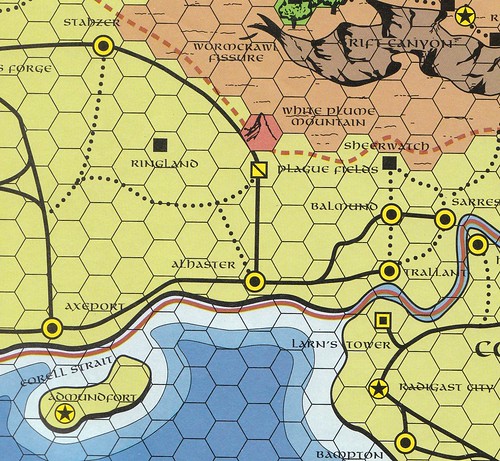
P.S.: Oh yeah, the map is from Darklands, the best open-ended sandbox RPG set in the Holy Roman Empire that nobody's ever heard of.

P.P.S.: Oh, and here's Michael Bolton as Captain Jack Sparrow.

Monday, June 20, 2011

Wilderness hexes as dungeon rooms - Putting the "howl" in "howling wasteland"


I have a million good resources to stock wilderness areas. Choosing between them and then deciding how to apply them is the trick. My main source material for this latest campaign has been the monster encounter tables from the B/X rulebooks, and the Judges Guild random ruins tables to give the areas some character. Once you're used to the JG tables, one line can easily provide a launching point for tons of spot detail. But every ruin having a monster ends up being a bit excessive. And you certainly don't want a substantial treasure at each location. Nor do you want every entry to be a deathtrap. Of course you can just use your judgement, but the programmer in my likes to have a methodology to start with (which I then freely ignore to taste).

Then it occurred to me - why not just stock the hex like I was stocking a dungeon?

Using the dungeon room contents table from B/X, 2 of 6 rooms have a monster, 1 in 6 a trap, and 1 in 6 have "special" contents (the remainder standing empty). Rooms with monsters have treasure fully half the time, while trapped and empty areas contain loot less frequently (2 and 1 in 6, respectively). This, for me, is a perfectly acceptable ratio for outdoors areas, and it's scalable to whatever level of detail / population density / ruin frequency you want.

For example, I needed to stock a 10 hex x 10 hex area in a hurry for our last game. I went through every hex in order, rolling d2 ruins results for each one. For each of these ruins, I rolled the standard d6 dungeon contents roll - if monster was indicated, I stocked the lair from the Expert Set tables (note that more than a few of these end up being men or demihumans). If it came up trap, the item/location was described as being potentially harmful to the players (this is a great way to throw in wilderness hazards like rockfalls and quicksand, BTW). "Special" results got "lost world" / weird fantasy-type stuff (gates, lasers, dreamworld crap, etc.), and empty "rooms" just got an unihabited / unguarded ruin or relic.

This process went smoothly enough with a notebook just jotting notes - when I added Tablesmith to the mix, it got a hell of a lot faster. JudgesGuild.com has the Ruins & Relics tables in TS format, which is just beyond fucking awesome. (TS is free to use, but there's a $10 registration to disable the nag - I STRONGLY advise you to check out the program and see if you don't think 10 bucks is actually a steal, and to consider registering.) This is an amazing piece of software for anybody that loves tables. You know you want it.

So, basically I end up with 100 hexes, each with one or two "somethings" in it (on top of the handful of locations already included from the Silver Princess wilderness map). Enough of those are monster lairs that you can get in a fight in maybe every other hex without me adding new creatures to the map, which is about right for the "first stock" by my tastes. As the players wander they'll uncover (and/or slaughter) map contents gradually, but the timed encounters will also _add_ new results to the map - so "restocking" is, I guess, almost automated? We'll see how that works in play, at least.

- DYA

Monday, June 13, 2011

Valley of the Silver Princess (or, "How to See Gulluvia On 50cp a Day")


Running House D&D this Wednesday, or so I'm told. ("House D&D" being "Basic D&D with housemates and associates, including girlfriend-types and not specifically aimed at super grognards the way we usually roll around here".) Last time (the first time), we ran one session of the (banned) orange-cover version of B3 Palace of the Silver Princess (weirdness very much in - see HERE for details (UNLESS YOU'RE PLAYING AND THAT MEANS YOU, YOU SNEAKY ENGLISH K'NIGITS)). They spent most of the session getting there (jumping around city roofs and playing 007 before getting to the green dude with the hook), and then proceeded to make it a hundred feet or so in, blunder into a pit trap, and get their asses more or less handed to them by militaristic kobolds. Barely managing to force a failed morale check, driving the overly-effective dogmen away, the party limped back to the entrance, short a player character.

So now they're in need of warm bodies and an outfitter. (Besides the dead PC from last time, we may have one or two new players.) They're in poor shape for the "wander around until we inevitably run across imprisoned adventurers" thing, so that means travel. I'm loathe to handwave such things - sure, you can say "you get to town X with Y random encounters on the way", but I dig when things evolve a bit more organically. TO THE MAPPING CHAMBER.


I'm basing this on the overland map in (orange-cover) B3, sort-of-mostly shoehorned into the corresponding area from the Mystara map included in the D&D Rules Cyclopedia. Which is not to say I'm giving much if any weight to the Mystara stuff that's gone before - the material from B3 is pretty clearly out of line with what's been published for this area since, and I'm not a huge Mystara scholar anyway - but I figure I have the RC, and the pretty map pages in it, I may as well make use of it for the surrounding areas. Most of what I've done here is actually just North of the extreme Northwest corner of the RC Mystara map - which also means that the Western border of my map is "off the charts", even in the source material. So that's where I can get freaky-crazy - I'm envisioning a vast, weird steppes area populated by barbarians and giant animals (stolen from Judges Guild, natch), with a spice road across it and lots of "on the road" zaniness. With a nice, dangerous reputation to keep folks away from it before I've actually done any of the design work, of course. :D

With that context in mind, I spent some time mapping the locations and routes (roads, paths and rivers) from B3 onto my RC-based hex map. (Using the 5-mile Judges Guild scale for this.) (Yes I know it was supposed to be 15 miles, no I don't care.) Some map distortion crept in getting things to fit where I wanted them, but I managed to more or less preserve the distances between locations, so fuck it. From there, we have a pretty bare map. Time to flesh it out.

Using the "habitation" table from the AD&D DMG (pg. 173), I rolled the "chance of habitation" for every hex in a 15 x 15 hex area. Any weird results (assuming that the main towns were those on the map, and that there weren't a bunch of extra cities, for example) were massaged out (either moved somewhere useful, or ignored). Got a bunch of small thorps & hamlets, a ton of individual settlements / camps, and more than a few ruins. Using the "race of settlement ruler" table from Kellri's GDD#4, we find that there are a lot of displaced dwarven settlements in the area (presumably refugees from the Palace's fall) (used tons of Dwarf Fortress names for these, of course), and a couple of powerful retired adventurers living in the valley as well.

And here's where we're at (with water colored in, figuring not much there is gonna change or need erasing at this point):


With the terrain and main settlements arrived at, I have a pretty good basis to fill in the blanks with lots of results from the Judges Guild ruins & relics table, and then it's hexcrawl time. YEEAAAAAAAAHHHHHH

- DYA


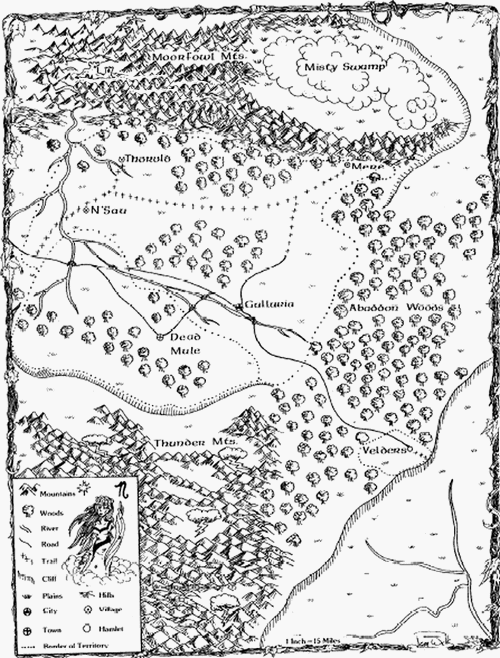
Edit: I figured it'd be illuminating to include the map I based my work off of. So there.

Friday, March 25, 2011

Repurposing Battletech Maps (or, "Re-Re-Inventing The Wheel")


School is very very crazy and gaming is pretty few and far between, lately, so I was psyched to have a chance to break out the Battletech stuff (for the first time in a loooong time) the other day. (Got two weeks off until it's back to Crazy Robots and Polygonland.) Introduced one of the roommates to tabletop BT - he's an old hand at the PC series, so most of it was already familiar. We did a pretty standard "attack/defend" scenario, just 'mechs (no combined arms stuff like tanks or infantry) and strictly 3025 designs (and level 1 rules). Today we'll probably do something similar, and then maybe we'll start working in the non-'mech stuff. I've always been curious how that mode of play goes - all my BT experience has been strictly 'mech-on-'mech.

So I'm reading the Mechwarrior book (the RPG chocolate to BT's boardgame/mini hybrid peanut butter), and there's discussion of running man-to-man combat using the standard Battletech maps (with a 5 meter to a hex scale). This looked lke fun, but it also occurs to me - why not use Battletech maps for other games where outdoor combat comes up a lot? I've never been a huge fan of wilderness layouts drawn on battlemats - visually it just doesn't work for me the way it does with dungeons - but I already own a big pile of hexed-out terrain sheets, with beautiful art no less. Next time I have occasion, I'm gonna whip out a few BT mapsheets and see how it flies. (The big decision: What scale to use (the hexes are a little bigger than the 1" I'm used to on my mat), and whether to bother restricting figures to the hexes, or to just use a ruler (a la traditional mini wargaming).

Of course this repurposing thing is nothing new - our learned and crusty readers will already be aware that Avalon Hill's Outdoor Survival map was the original wilderness map for Gary's home game. Has a nicely circular feel, this.

It occurs to me as well that AD&D inherited OD&D's outdoor scale of 1" to 10 YARDS (as opposed to feet, as it is in indoor settings like the dungeon), and off the top of my head I can't remember whether Classic D&D followed suit. (The next chance I'll likely get to use this is our still-fledgling house Red Box game - the guys (and gal) came out of the Palace of the Silver Princess with one less adventurer than they went in with, and are considering making the trek down out of the mountains into the valley below, in search of able sword-arms and a decent outfitter.)

This would be a great fit for Traveller, as well, especially if I ditch Trav's assumed scale - the old Snapshot ship maps are beeeeyootiful, but who the hell wants to track down 15mm sci-fi minis when most everything else I play is 28mm and up?

- DYA

Monday, December 14, 2009

Wilderlands of 'Hawk Fantasy - Hexcrawl Notes


In designing the wilderness area for my Greyhawk campaign, I'm finding that I have a million and one choices to make as to my "wilderness procedures", and that these will shape a) how I prepare my material, and b) how smoothly the game runs when we're in the thick of it.

It all comes down to encounter checks (of several varieties). In order to capture the level of simulation (and risk vs. reward) I'm looking for, I'm going to have time-based encounters (as per the DMG - checks at predefined intervals during the day) and exploration-based encounters (1 check for every new hex entered, probably a 1 in 6 or a 1 in 10, with the chance for encounter increased in dangerous hexes like mountains and forests). Exploration checks will draw from nearby lairs (with a chance to find the lair itself based on "% in lair"), while time-based checks will be from a terrain-based encounter table (and may add new lairs to the map, again depending on the "% in lair" rolled). Encounter checks within a few hexes of settlements will have a chance of being converted into a "patrol" encounter (which may or may not benefit the PCs, depending on what they've been up to lately), while encounters on a road or frequently-traveled trade route will use a dedicated "on the road" encounter table (which itself contains a certain chance of monster encounters).

I'm also splitting "creature checks" (monsters, travelers, patrols, etc.) from "location checks" (ruins, relics, settlements, etc.). Passing through a hex, I'll roll a "chance to spot" for each listed (and previously undiscovered) ruin or relic in the hex (setting this on-the-fly - something small but in the open would be a 1 in 6, something big a 2 in 6, a settlement 3 in 6 assuming it's out in the open, while something concealed might be a 1 in 8 or 1 in 10). Searching a hex will take as long as crossing the hex twice, and will allow another roll to spot (with the chance to spot improved by 1). If the PCs spot nothing (or they've already discovered everything in the hex), I'll roll a 1 in 6 chance to discover something new (taken from a pregenerated list of unassigned R&Rs) and add it to the hex. (I expect frequently-traveled wilderness routes will become quite detailed as the campaign matures.)

Now, I know the chances to spot something in an actual 25 square mile area are miniscule, but this is a game conceit I'm willing to live with. I'm generating between 1 and 3 locations for each hex on my initial pass-through - it's to be assumed each hex contains many more than this, and that the others will be added on subsequent passes (once the pregenerated ones are discovered). This is all conjecture until it actually sees play, of course - I'll hopefully get to try it Tuesday, and I'll check in to report how it goes. I'm aiming to have three full "Darlene hexes" (the 30-mile hexes from the folio map) detailed at "Wilderness Grand Tactical" scale (5-mile hexes) by then, and I'll let the players know that if they get off that map, then the FPS (fights per second) of the game is going to slow drastically (while I whip up new crap).

-DYA

Thursday, April 23, 2009

MY WORK IN PROGRESS IS A WORK IN PROGRESS


Now that I've abandoned the Known World map as a home for Zent-Mer, I have the happy task of creating a new wilderness map.  I'm weighing how much I want to plan out now, and how much I want to leave to random chance and/or development during play.

On the one hand, planning in advance lets me do an awful lot of "stocking" ahead of time.  Starting play with a fully-detailed wilderness area is certainly an attractive proposition.

On the other, it's a lot of work up front.  It's possible that a more organic approach, like generating "unlocated" hex contents and assigning them as the party travels, could be a good compromise.  Maybe with a few large hand-placed landmarks (like oceans, the big mountain ranges and forests, etc.).

I'm also trolling around trying to round up as many random terrain / hex contents / inhabitation generation methods as I can, in order to compare them and arrive at a solution for my campaign.  So far, the 1e DMG, Kellri's (completely indispensable) CDD#4 Old School Encounters Reference, the JG Wilderlands of High Fantasy and Dave Arneson's First Fantasy Campaign are the main sources.  (If you know of any others, hook it up!)  I also have a copy of the 2e-era "Worldbuilder's Guidebook", which takes a slightly more "top-down" approach than I had initially planned, but still could be worth another look.  (One of the better supplements from this era, for my money.)

Once I come up with an overall system I like, the real fun of actually generating this sucker comes in.  Me and the Ravaged Ruins tables are gonna get very cozy for a few minutes.

DYA